There is a small genre of parental bewilderment that goes: the hardest exercise got done, the easiest one did not. Reading at the top difficulty setting, finished. Maths, finished. A spelling rule that the child demonstrably knows, abandoned halfway, the one task of the week that quietly ate the largest share of the time. The dashboard has an opinion about this, and the opinion is “needs more practice on the spelling rule”. I would like to argue that the dashboard is answering a question nobody asked it.
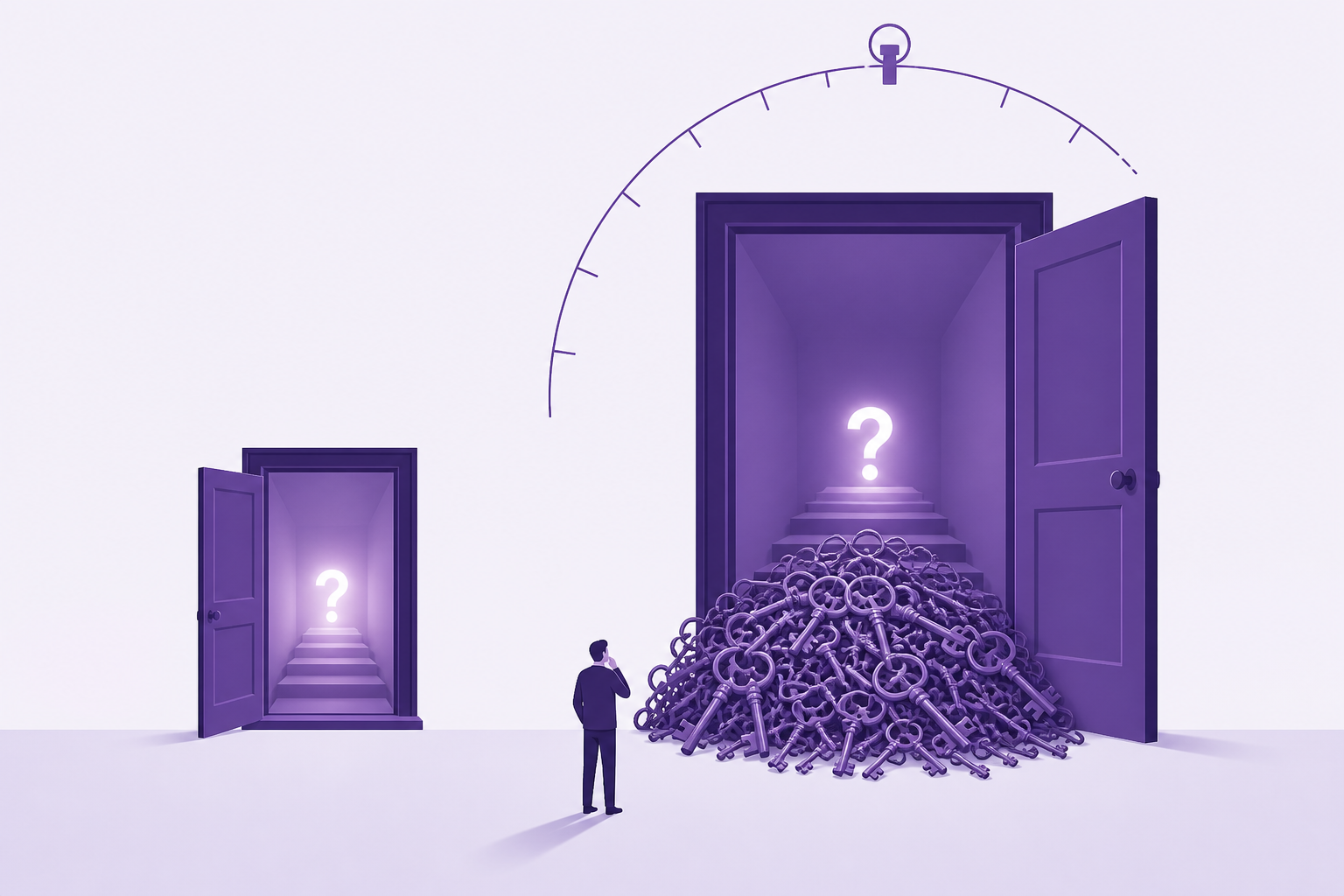
One task, two bills
Consider what an exercise actually charges you for. Typing a word into a blank in a sentence asks for a judgement about the spelling rule, and also asks for a keyboard: find the letters, assemble the whole word, notice the typo, fix it. For an adult these two bills are paid in the same instant and nobody sees the second one. For a child of primary-school age whose typing is still a conscious act, the second bill can be many times larger than the first, and it can drown the first entirely.
The report card cannot tell the difference. It sees “not finished”, and a modest accuracy figure, and it files the problem under knowledge. Which is where the real trouble starts, because the prescription that follows is more spelling practice, delivered in the same typed format, which is slower still, which produces more abandonment, which looks more and more like a child who does not know the rule. An input bottleneck, misread as a knowledge gap, feeds itself.
The way out is almost insultingly cheap. Keep the rule fixed and change only the way of answering: hear the word, tap one of two options. In the case I watched, the same rule that had been the week’s casualty went by at a few seconds a question, with nearly every answer right. That settles the order of suspicion. When the easiest thing is the thing that gets dropped, check the cost of answering before you check the content.
I should say what this does not show. Two options means a coin-flip floor, so the accuracy has to sit well above half before it means anything. A tapped answer proves the child can judge; it does not prove they will write the word correctly in a sentence of their own. And it is one learner over two weeks. This is advice about which question to ask first, not a theory of typing.
The redo, and the direction of time
The second observation looks unrelated and is the same problem in different clothes. A child went back, unprompted, and redid an exercise that already counted as finished. Nobody asked, nobody rewarded it, it appeared in no statistic. The temptation is to read this as a good sign. But “she did it again” carries no information by itself, in the same way that “he went to the library” carries none until you know whether he read anything.
What carries information is the direction of the time spent. A redo that is much faster than the first attempt, with the same wrong answers in the same places, is the clearing of a checklist: the object of the behaviour is the unfinished marker. A redo that is slower, with the pattern of errors shifting, is someone working on the content. On the transcript both are “attempted again”. On the stopwatch they point in opposite directions.
This is also why time is the cleaner instrument when an exercise is repeated. A score on the second attempt is contaminated by remembering what you chose last time. Time is not contaminated in that way, because remembering the answers can only make you faster. So a repeat that gets slower and better cannot be explained by memory alone, which is a rather elegant bit of free experimental design.
It carries a corollary that I find a little sad. The signal exists only while it is spontaneous. The moment someone praises it, schedules it, or awards points for it, it becomes an action that can be completed in under a minute, and the instrument is gone.
Read the clock before the score
Put the two together and you get a rule of thumb that fits on a sticky note. Accuracy tells you how many were right. Time per item tells you what each one cost. When the two disagree, believe the clock. A stretch of fast, evenly correct answers whose second half collapses into a few seconds each is rarely “stable”. It is more often someone finishing rather than thinking.
The rule has a procurement consequence nobody will enjoy. A learning platform that records only percentages cannot support any of the diagnoses above. One that keeps every attempt, the wrong options chosen and the time per item can. I would weigh those three features above adaptive difficulty and a long way above the badges.
And the rule has a modest ethical one. Before saying a child cannot do a thing, find out what it costs them to say it. The answer is frequently not the one on the report.