I went to the same conference twice, two years apart, and the second time it had swapped its bones. In 2024 the talk was about teaching practice: how to bring AI into the classroom, which tools were worth the licence fee, whether the students would cheat. This year, in Vienna, almost everything of consequence was about assessment. Not about whether AI can pass our exams — that argument is over, and it won — but about what our exams were measuring in the first place, and whether we would want to defend the answer out loud.
I should say at once that I am one attendee at one conference in one field, and a conference programme is not a survey of a discipline. My paper was not accepted this year; a colleague working on assessment had theirs accepted. That is a sample of one, and I know what it is worth. But the impression was hard to shake, and it came with an argument attached.
Assessment is the lever, and also the noose
The argument goes like this. You can encourage curriculum innovation all you like. You can send every teacher to a workshop and let them try whatever they want in the classroom. But as long as assessment still rewards the old competence, the old behaviour and the old study strategy, the system will quietly snap back to where it was. Assessment is not the last link in the chain. It is the thing that defines competence, and everything upstream — outcomes, curriculum, how students actually study, what supervisors look for — bends to fit it.
This is the optimistic reading, and I mostly believe it. The pessimistic reading was on a slide that said only Outcome Obsessed, and it deserves equal time. If you build education around what is measurable, learning gets flattened into whatever fits a rubric. The same lever that moves the system can also narrow it. The honest question is not how do we measure more, it is what kind of learning are we trying to make visible. Nobody in the room pretended this was settled.
The word I came home with
The word was never-skilling, and it is a better word than the one we have been using.
Deskilling is what happens when a skill you already have decays from disuse. It is the pilot who has not hand-flown an approach in three years. That is a real problem, but it is not the novice’s problem. The novice’s problem is that the skill never forms at all. Every case arrives, the answer is available immediately, the output looks fine — and the loop that grows expertise simply never runs.
The loop, spelled out, is unglamorous: notice the cues, activate what you already know, hold two hypotheses against each other, be wrong, revise, reorganise. Experts are not fast because they have stored more facts; they are fast because their knowledge is organised into structures that clinical cues can activate directly. That organisation is built by running the loop, and only by running the loop. Which gives the sentence I have been repeating to people ever since:
Performance gain is not learning gain.
Note that this cuts both ways, and the second edge is the one people miss. An AI that hands over the answer skips script formation. An AI that asks which cues matter here, and what would change if the context changed is scaffolding script formation. Same technology, opposite effect on the learner, and most of the public argument about students getting dumber does not distinguish between the two at all.
Two driving tests
So what do you do with an assessment system when the artefact a student hands you was co-produced? You can no longer read a student’s note and infer the thinking behind it. That inference was the whole basis of the thing.
The answer converging in the field is not to abandon unaided assessment, and not to pretend the AI-assisted world away. It is to test both, deliberately, as two different conditions. Can you reach a defensible conclusion without the tool? And separately: can you frame a good question to the tool, appraise what comes back, notice where it diverges from your own judgement, calibrate how much to trust it, and explain to a colleague how you got where you got?
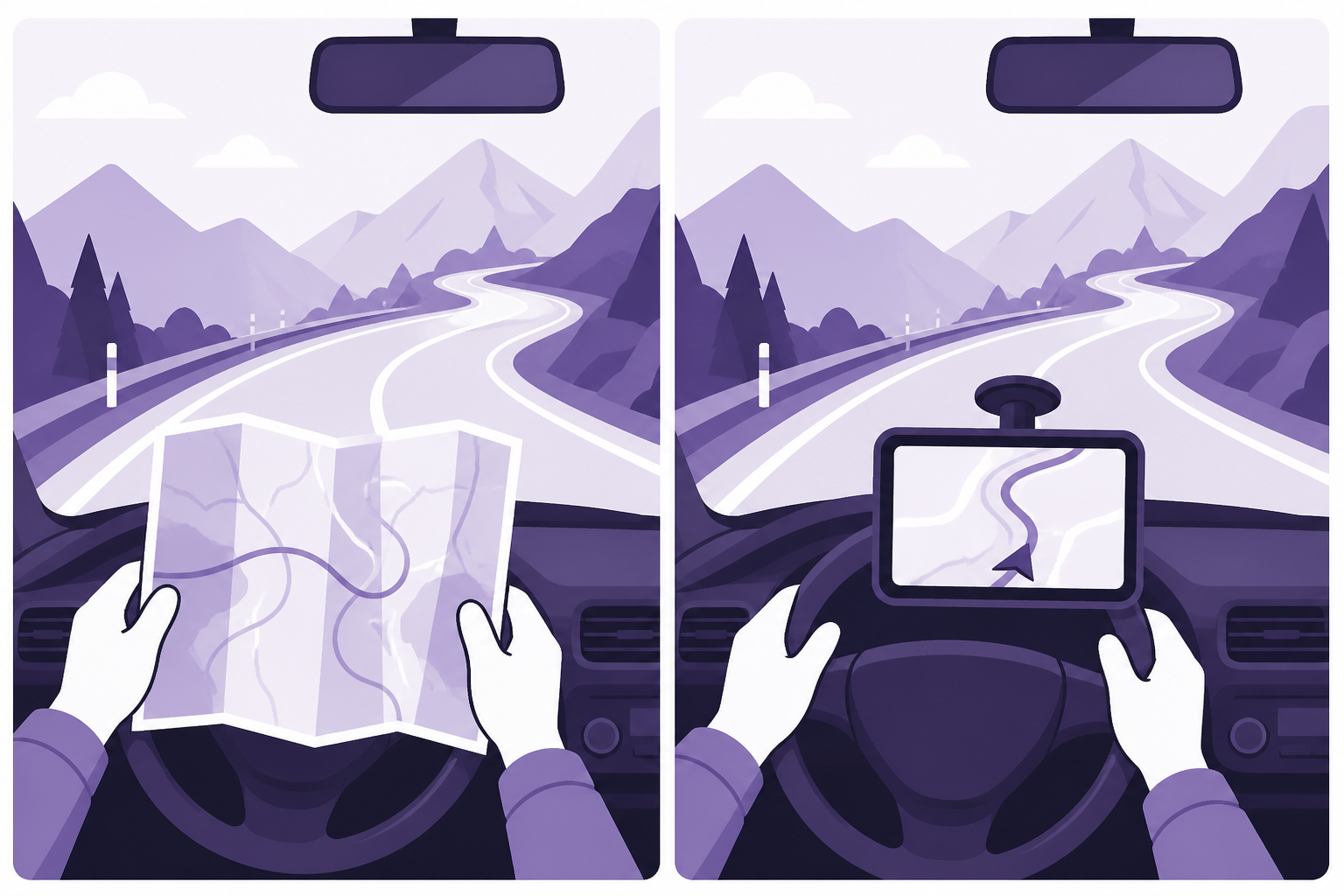
The analogy someone used was the driving test, and it is the most useful thing I brought home. We would want to know both that you can drive without satellite navigation, and that you can use satellite navigation without driving into a canal. Future competence is not human competence or AI competence. It is competence across both conditions.
What is not solved
Two things, and I would rather state them than sell the tidy version.
Testing both conditions costs roughly twice as much, and nobody in Vienna explained how a real curriculum affords that. And assessing the interaction, rather than the answer, requires capturing the interaction, which is an infrastructure problem wearing a privacy problem as a coat.
Then there is the finding that embarrassed everyone slightly. The obvious pedagogical fix is to make the learner commit to their own reasoning first, and only then let them consult the AI — reasoning first, tool second. It is a good principle. It is also, in at least some experiments, not enough: people who wrote down their own reasoning before seeing the model’s output still ended up performing worse together than the model did alone. Human-plus-AI is not reliably better than either. The relevant unit of analysis is the human–AI system, and we do not yet know how to design it well.
I find that reassuring rather than otherwise. It means the interesting work is still ahead of us, and that the people doing it are willing to publish the result that does not flatter the principle.