I signed my child up for the summer camp for the least noble reason available. The holiday here runs six weeks, six weeks is a long time to fill, and I wanted one of those weeks to belong to somebody who was not me. My expectations were correspondingly modest: a field, some supervision, a child returned in the evening in roughly the condition she departed in. This is, I think, the standard parental transaction, and I entered into it without ceremony.
What I got instead was a village handing me a hammer.
The thing that is not the point
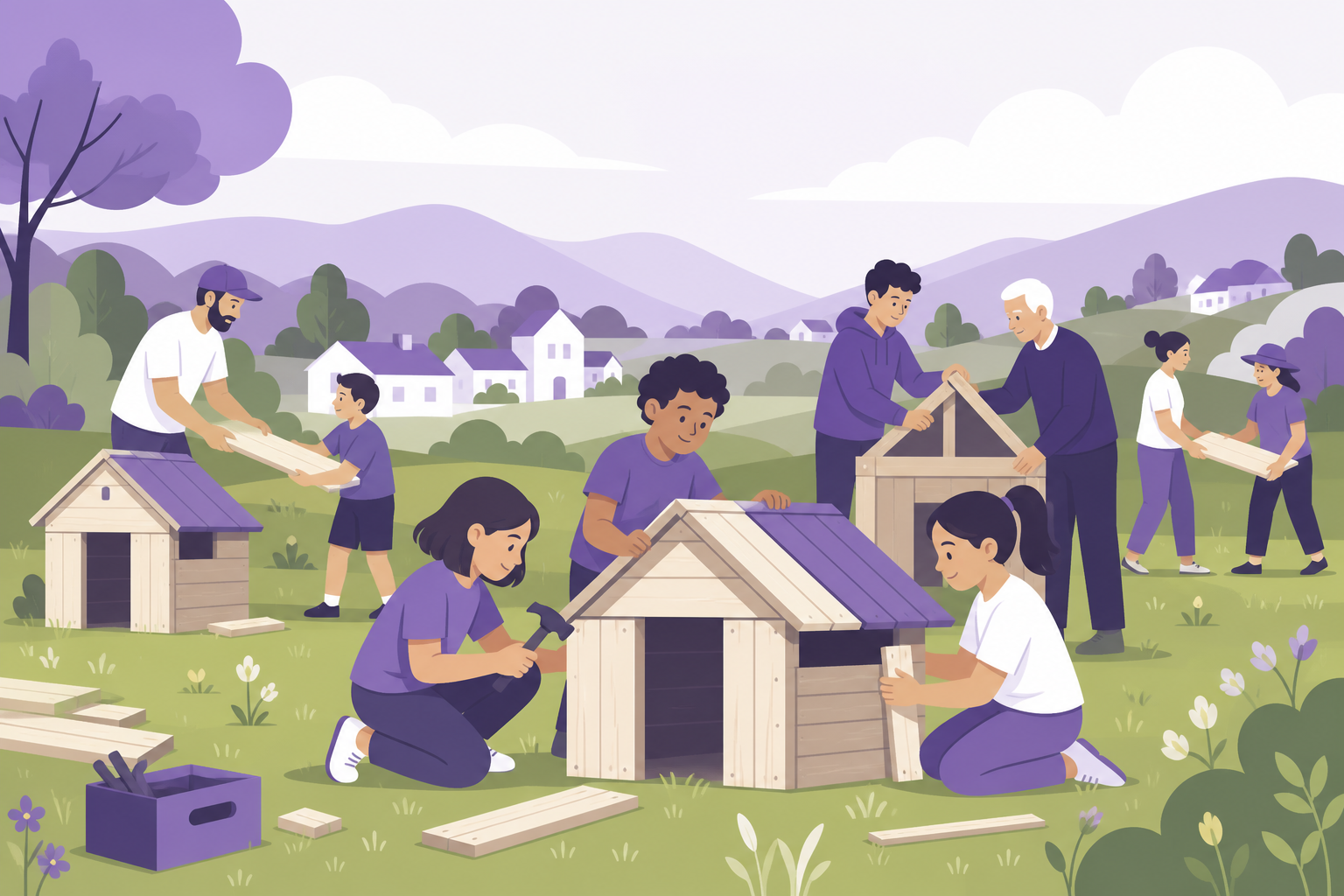
The visible activity is easy to describe. On Monday the children arrive with hammers and are given a pile of scrap wood, and they build sheds. On Tuesday they paint the sheds. Wednesday is a sports day. Thursday afternoon they run feral, and that night they sleep in the structures they built themselves, which either hold or do not. On Saturday the parents are let in and the children perform a short play, which is the traditional tax children levy on parents for a good week.
None of this is the interesting part. Summer camps have existed for a century and most of them can arrange a hammer.
The interesting part is what happens on the Saturday before camp, when the entire village drives around collecting the raw material: wood, water-based paint, tarpaulins, old furniture, tools, crates, brushes, nails. The list of refusals is longer and more revealing — no glass, no non-water-based paint, no asbestos, no roofing sheet, no corrugated panel, no plasterboard, no furniture with glass in it, no mattresses. Someone has clearly thought about what a nine-year-old with a hammer can do to a sheet of plasterboard. The organisers say publicly that they sort ruthlessly, and that if your donation is rejected it is because they believe it is unsafe. They are, in other words, willing to tell a neighbour no.
Then I looked up how long this had been running and found the answer: since 1966. A handful of villagers started it themselves, informally, with no institutional backing whatsoever. In 1974 the municipality came in and it acquired a foundation and a legal existence. It has run every summer since, and paused exactly once, in 2020, for the obvious reason. The volunteers who run it were, in very large numbers, once the children building the sheds.
That is the mechanism. Village runs camp → children grow up inside camp → children come back as volunteers → village runs camp. Sixty years of a loop closing on itself.
Which reframes the whole thing. I had assumed cohesion was a pleasant side effect of a well-run children’s activity. It is the other way round. The activity is the pretext. Cohesion is the product.
Four percent
There is a sociological name for the shape of what I was looking at. James Coleman called it intergenerational closure: the network only closes when the children are friends with each other and their parents also know each other. Coleman’s point was that a parent then has a second channel of information about his own child — through the child’s friends, through those friends’ parents, and back around to himself — instead of relying solely on the child’s own testimony, which is a famously unreliable source.
Windzio and Kaminski put numbers on this in 2023, using three waves of network data from German public schools. The number that stopped me was the density of the parent network: somewhere around four percent. In an ordinary school class, four percent of the possible parent-to-parent connections actually exist. Whatever “the village” is supposed to mean, in the default modern condition it does not exist. It has to be manufactured.
Their second finding is the one I keep turning over. Closure can form top-down — parents meet, then their children become friends — or bottom-up — children become friends, and their parents get pulled into contact afterwards. Both paths are real, but the bottom-up path is roughly four times stronger. Children are the more effective social infrastructure. Adults, left to themselves, are not very good at this.
I should be honest about what the paper does not show, because the temptation to over-read it is enormous. The correlation between closure and classroom violence only appears in the third wave, and it is not statistically significant. Eleven of the twenty-one classes had to be dropped because their parent networks were too sparse for the model to converge, which the authors themselves flag as a problem for inference. The two coefficients are not directly comparable. And the whole thing is correlational — there is no causal claim here, and the wider literature does not agree with itself about what closure actually does. Nobody has demonstrated that building a shed makes a child better. I am not going to be the first to try.
The direction of the arrow
Here is the tension I find genuinely interesting, rather than merely heartwarming.
The paper says the network mostly closes from the bottom up. But this camp started from the top down: in 1966 it was adults who moved first. Both are true, because they are two halves of the same loop seen at different timescales. Adults started it once. Children have kept it alive every year since, by growing up and coming back. The top-down move was the ignition. The bottom-up loop is the engine.
And the collection drive, which sounds like the least significant detail, may be the load-bearing one. It gives every household a material stake in structures they did not build and will not sleep in. The barrier to entry is putting an old cupboard on the kerb. That is a low enough bar to clear while distracted, and it quietly makes the whole village a shareholder.
What it costs to be let in
I came to this country from elsewhere, and I have learned that a functioning local community is far harder for an outsider to enter than a functioning local economy. Work you can apply for. Language you can study. There is no application form for a village.
The route in, it turns out, is a child. My daughter went to build a shed, and by the end of that week I knew the names of people I would otherwise have nodded at for another decade. I did not integrate into anything. I was pulled in sideways, through a seven-year-old, along the bottom-up path that the data says is four times stronger than the one I had been consciously attempting.
There is no lesson in this that I am prepared to defend with evidence. What I have is a mechanism and an observation, and the mechanism is this: a village that wanted its children to have something to do accidentally built an apparatus for manufacturing the scarcest resource in modern life, and it did it with scrap wood, water-based paint, and a rule against mattresses.